Tell us about the job
Takes about a minute. No obligation.
A compressor in Beaver County works a short, concentrated stretch each year and carries nearly every cooling demand the house has in a tight window. Homes in Beaver County, UT run cooling about two months a year, from July through August. Because the season is brief, a fault that develops early stays hidden until the system is under full load, and by then the contactor and condenser fan have already cycled hard enough to show wear. A contractor diagnosing a repair here looks at the compressor and the contactor closely, because those are the components that take the full hit of whatever the season demands.
Half the homes in Beaver County, Utah were built in 1976 or earlier (2020-2024 ACS 5-year). A central AC repair call in houses like these often surfaces more than the failed part. The equipment a contractor pulls open may be younger than the building around it, but the electrical circuit feeding it was not always updated when the unit was swapped. If a breaker or run of wiring is undersized for what the system actually draws, a repair that looks straightforward on the surface stalls until that gets resolved. The ductwork raises the same question: seals and connections in stock this old deteriorate, and a refrigerant or airflow problem can trace back there rather than to the unit itself.
The Parts of a Central AC a Contractor Checks First
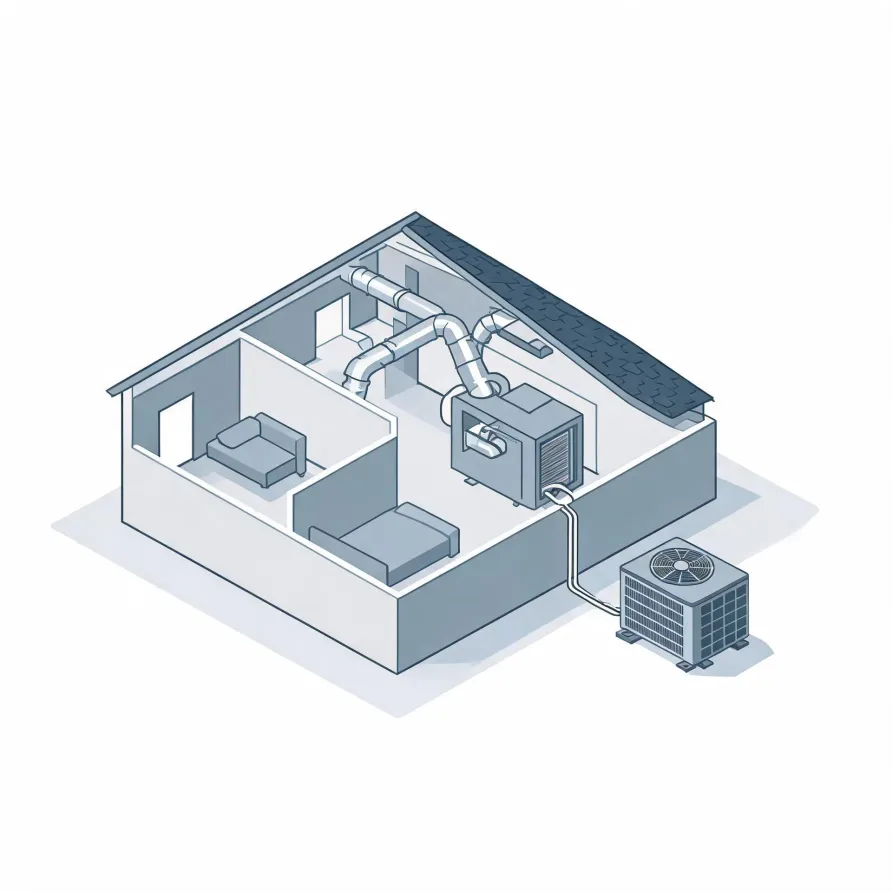
The outdoor condenser unit sits outside the house, usually beside or behind it, and it is where heat gets expelled. The indoor air handler or furnace-mounted evaporator coil sits inside, typically in a basement, closet, or utility space. When the system blows warm air, makes noise, or stops running, these are the pieces a contractor looks at first.
The refrigerant lines run between those two units, carrying the working fluid that makes the whole system function, and the expansion valve controls how that fluid moves. The thermostat on the wall is also part of what a contractor checks, because a wiring fault or a failed sensor there can mimic a much larger problem.
The drawing shows a general layout of how these parts relate to one another, and a licensed contractor determines what applies to your specific house and setup.
Get matched in Beaver CountyBeaver County, Utah, by the numbers
88 severe weather events were recorded in Beaver County, Utah between 2015 and 2024.
NOAA National Centers for Environmental Information, Storm Events Database, bulk CSV export, events 2015-01-01 through 2024-12-31.Half the homes in Beaver County, Utah were built in 1976 or earlier (2020-2024 ACS 5-year).
U.S. Census Bureau, 2020-2024 American Community Survey 5-Year EstimatesBeaver County, Utah holds 2,969 housing units (2020-2024 ACS 5-year).
U.S. Census Bureau, 2020-2024 American Community Survey 5-Year EstimatesOwners occupy 81.0% of the occupied homes in Beaver County, Utah (2020-2024 ACS 5-year).
U.S. Census Bureau, 2020-2024 American Community Survey 5-Year EstimatesCodes & Standards Governing Central AC Repair in Beaver County, Utah10 sourced rules and standards
What HVAC Repair Looks Like in Beaver County
Split-system central air conditioners rated below 45,000 Btu/h manufactured on or after January 1, 2023 must meet a federal minimum of 13.4 SEER2.
Split-system central air conditioners rated at or above 45,000 Btu/h manufactured on or after January 1, 2023 must meet a federal minimum of 13.4 SEER2.
Split-system central air conditioners manufactured between January 1, 2015 and December 31, 2022 had to meet 13 SEER, the metric that preceded SEER2.
Single-package central air conditioners manufactured on or after January 1, 2023 must meet a federal minimum of 13.4 SEER2.
Space-constrained central air conditioners manufactured on or after January 1, 2023 must meet a federal minimum of 11.7 SEER2.
Federal efficiency standards for split-system central air conditioners and heat pumps are set on each certified combination of outdoor unit and indoor coil rather than on the outdoor unit alone.
Residential and light commercial air conditioning and heat pump systems assembled in the field, including mini-splits and unitary systems, may not be installed on or after January 1, 2025 using a refrigerant with a global warming potential above 700.
A field-assembled system whose specified components were all manufactured or imported before January 1, 2025 carries no installation compliance date under the refrigerant restrictions and may still be installed.
Licensing Rules for Beaver County, Utah
Utah’s contractor licence does not reach alteration, repair, remodelling or improvement of a building worth less than $7,000 in labour and materials together, counting every change and addition to the agreed work — though the plumbing and electrical trades are pulled back under licensure even below that figure.
Utah requires a state licence before engaging in a licensed construction trade or contracting activity, and HVAC contractor is one of the licence classifications the state issues.
Severe Weather Events in Beaver County
Storm activity puts stress on AC equipment long before a failure is obvious. Refrigerant lines, capacitors, and electrical connections all take a hit from the kind of weather this area sees, which is why local repair demand follows local conditions.
88 severe weather events, 2015–2024. Source: NOAA National Centers for Environmental Information, Storm Events Database.