Tell us about the job
Takes about a minute. No obligation.
Central AC repair in Daggett County starts from an unusual position. Homes in Daggett County, UT have essentially no cooling season — no month of the year is warm enough to call for it. A compressor that sits dormant for the entire year does not escape wear; seals dry, refrigerant migrates, and contactors corrode without the regular cycling that would otherwise keep them seated and clean. When a homeowner calls because the system will not start, the contractor is looking at storage-mode failure modes rather than the overwork patterns common to hotter regions. Capacitors and contactors are the first things opened up.
Older ductwork in Daggett County was sized and routed for systems no longer in production, and each round of replacement since has worked around what was already there rather than starting fresh. Half the homes in Daggett County, Utah were built in 1979 or earlier (2020-2024 ACS 5-year). That history means a contractor opening a failed unit is also contending with connections, fittings, and configurations built around equipment long out of manufacture. The parts a current system takes may be available; the parts an older one needs, adapted into ductwork from a different era, often are not, and that gap is what turns a straightforward repair into a sourcing problem.
The Parts of a Central AC a Contractor Checks First
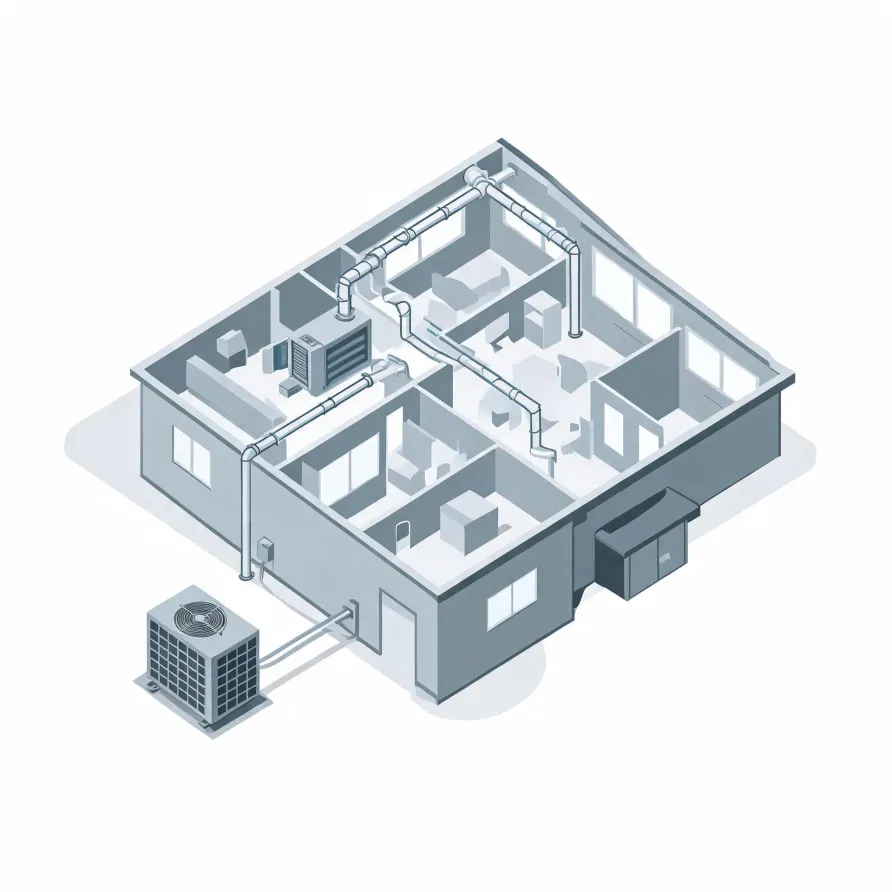
The outdoor condenser unit sits outside the house, usually beside or behind it, and houses the compressor and condenser coil. These are the pieces a contractor looks at first when a system stops cooling. A failed compressor, a refrigerant leak at the coil, or a burned capacitor all live in this cabinet.
Inside the house, the air handler holds the evaporator coil and the blower fan. The evaporator coil is where a refrigerant problem often shows itself as ice buildup or warm air at the vents. The blower moves conditioned air into the duct system, and a faulty motor or clogged coil will stop that delivery cold.
The drawing shows a typical central AC layout, and a licensed contractor determines which components apply and what condition they are in for your specific house.
Get matched in Daggett CountyDaggett County, by the numbers
38 severe weather events were recorded in Daggett County, Utah between 2015 and 2024.
NOAA National Centers for Environmental Information, Storm Events Database, bulk CSV export, events 2015-01-01 through 2024-12-31.Half the homes in Daggett County, Utah were built in 1979 or earlier (2020-2024 ACS 5-year).
U.S. Census Bureau, 2020-2024 American Community Survey 5-Year EstimatesDaggett County, Utah holds 1,163 housing units (2020-2024 ACS 5-year).
U.S. Census Bureau, 2020-2024 American Community Survey 5-Year EstimatesOwners occupy 82.3% of the occupied homes in Daggett County, Utah (2020-2024 ACS 5-year).
U.S. Census Bureau, 2020-2024 American Community Survey 5-Year EstimatesRules & Standards Covering Central AC Repair in Daggett County, Utah10 sourced rules and standards
What Happens When a Contractor Comes Out
Split-system central air conditioners rated below 45,000 Btu/h manufactured on or after January 1, 2023 must meet a federal minimum of 13.4 SEER2.
Split-system central air conditioners rated at or above 45,000 Btu/h manufactured on or after January 1, 2023 must meet a federal minimum of 13.4 SEER2.
Split-system central air conditioners manufactured between January 1, 2015 and December 31, 2022 had to meet 13 SEER, the metric that preceded SEER2.
Single-package central air conditioners manufactured on or after January 1, 2023 must meet a federal minimum of 13.4 SEER2.
Space-constrained central air conditioners manufactured on or after January 1, 2023 must meet a federal minimum of 11.7 SEER2.
Federal efficiency standards for split-system central air conditioners and heat pumps are set on each certified combination of outdoor unit and indoor coil rather than on the outdoor unit alone.
Residential and light commercial air conditioning and heat pump systems assembled in the field, including mini-splits and unitary systems, may not be installed on or after January 1, 2025 using a refrigerant with a global warming potential above 700.
A field-assembled system whose specified components were all manufactured or imported before January 1, 2025 carries no installation compliance date under the refrigerant restrictions and may still be installed.
Licensing Rules for Daggett County, Utah
Utah’s contractor licence does not reach alteration, repair, remodelling or improvement of a building worth less than $7,000 in labour and materials together, counting every change and addition to the agreed work — though the plumbing and electrical trades are pulled back under licensure even below that figure.
Utah requires a state licence before engaging in a licensed construction trade or contracting activity, and HVAC contractor is one of the licence classifications the state issues.
Severe Weather Events in Daggett County
Weather puts work on HVAC equipment, and the demands it places vary by location. Repair frequency in Daggett County is tied to what the local climate actually does to the systems running through it.
38 severe weather events, 2015–2024. Source: NOAA National Centers for Environmental Information, Storm Events Database.